
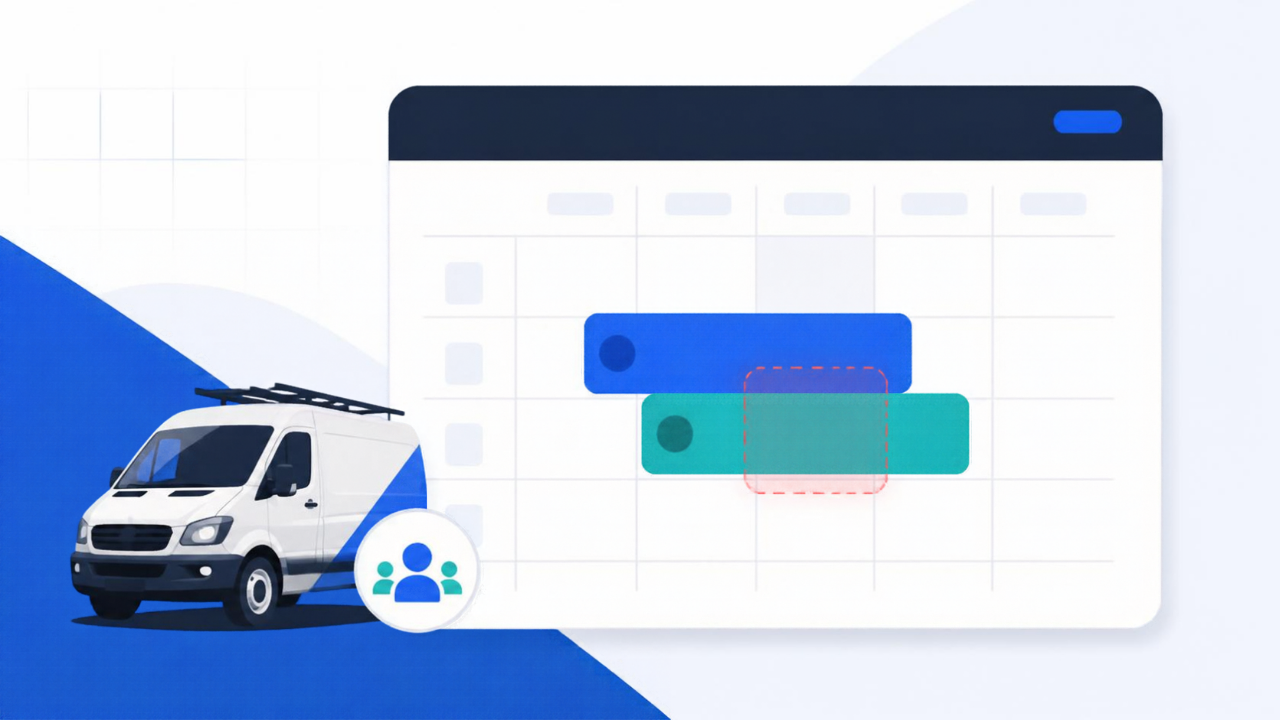
How to Avoid Double Booking Your Service Crew
How to avoid double booking your service crew is a question most service business owners only start asking after it already happened, usually in front of a client, usually on a morning when two trucks show up at the same address ten minutes apart. One crew gets sent home. One customer gets an apology instead of a cleaning, an inspection, or a mow. And you spend the rest of the day rearranging everyone else's schedule to cover the gap.
Why it keeps happening even when you're careful
Double bookings almost never come from carelessness. They come from running a schedule across more places than one calendar can hold. A customer books online through one form, a repeat client texts you directly to rebook, and a third job gets added over the phone while you're standing in someone's driveway with wet hands. Each of those bookings is reasonable on its own. Put together, without one shared source of truth, they collide.
The collision gets worse as the business grows, not better. A solo operator can hold the week in their head. Once you're running two or three crews, a schedule that lives partly in a paper book, partly in a phone calendar, and partly in someone's memory of "I think Tuesday's open" is a matter of when, not if. Cleaners, home inspectors, landscapers, and mobile techs all hit this at roughly the same headcount: somewhere around the third or fourth person on payroll, the informal system runs out of room.
The dispatch problem is really a data problem
Most double-booking fixes people try first are behavioral: check the book twice, confirm by text, have someone "own" the calendar. Those help at the margins, but they don't solve the underlying issue, which is that the booking data itself lives in more than one place. If a job can get onto the schedule through three different channels that don't talk to each other, no amount of careful checking closes that gap permanently, it just means someone has to manually reconcile three lists every single day, which is its own full-time task nobody signed up for.
The businesses that stop double-booking for good usually do one specific thing: they route every booking channel, online form, phone call, repeat-client text, into a single calendar that assigns a crew and a time slot before the job is confirmed, not after. That sounds obvious. It's also the step most service businesses skip, because it means giving up the flexibility of "we'll figure out who's going" until the day of.
On-site payment is where the second version of this problem shows up
Scheduling collisions are the visible failure. The quieter one happens after the job is done, when payment is supposed to happen on-site and doesn't cleanly get recorded. A crew collects a check or taps a card reader in someone's driveway, and that payment has to somehow make it back to the books without getting lost between the truck and the office. Cash gets pocketed as a tip that wasn't a tip. A check sits in a glove box for a week. A card payment gets run through a personal account because the company reader was in the other truck.
None of that is usually dishonesty. It's a gap between where the money changes hands and where the business actually tracks it. The fix looks a lot like the scheduling fix: one system that both assigns the job and records the payment against that same job, on the same device the crew already has with them, instead of a payment step that happens off to the side and gets reconciled, or doesn't, at the end of the week.
What a crew actually needs on the day
A dispatch system that works in practice gives each crew member exactly what they need for their stop and nothing else: the address, the job, the customer's notes from last time, and a way to mark the job complete and take payment before they've left the driveway. When that information lives in the same place the booking was made, a schedule change made at 7 a.m. actually reaches the crew that's already halfway to the first job, instead of getting stuck in a group text that someone reads at lunch.
This is also where crew accountability gets easier without turning into surveillance. A shared schedule with clear job assignments means everyone can see who was supposed to be where, which matters when a customer disputes whether the crew showed up on time, and it matters just as much when a crew member is doing exactly what they're supposed to and deserves credit for it.
The subcontractor version of the same problem
A lot of service businesses don't run on W-2 crews alone. A landscaping company brings in a subcontracted crew for the busy season. A home inspection business pulls in a licensed contractor for specialty inspections it doesn't handle in-house. Those arrangements add a payroll layer on top of the scheduling layer, and if the two aren't connected, you end up doing two jobs twice: figuring out who worked which job from the schedule, and then separately figuring out what each subcontractor is owed for it.
This is where a lot of double-booking fixes quietly fall apart. A business can solve the calendar-collision problem and still be reconciling subcontractor pay by hand at the end of every pay period, cross-referencing the schedule against a separate spreadsheet of who's owed what. The job assignment and the pay owed for that job are the same piece of information, viewed from two directions. Keeping them in two different places guarantees they'll eventually disagree with each other.
FocalVA handles booking, dispatch, crew scheduling, subcontractor payroll, and on-site payment in one system, so a job that gets booked online, over the phone, or by text all land on the same calendar, and payment gets tied to the job the moment it's collected. If double bookings and lost on-site payments have become a normal part of a Tuesday, see how FocalVA works for service businesses.